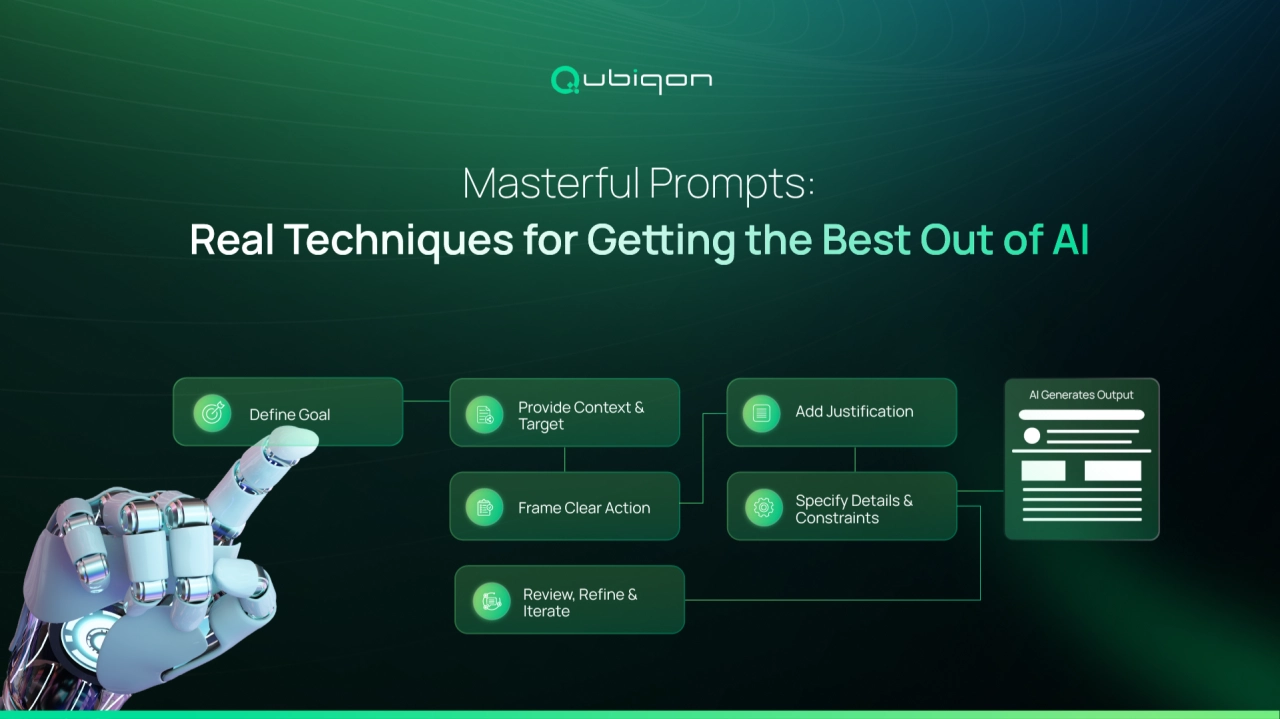
Artificial Intelligence has transformed the way we work, learn, and interact. But getting value from AI is not about asking random questions - it’s about asking the right questions. The difference between a mediocre answer and a breakthrough insight often comes down to how you craft your prompts. This discipline, known as Prompt Engineering, is quickly becoming the cornerstone of AI-native development.
A well-structured prompt acts like a roadmap-it gives the AI clarity on your goal, context, constraints, and even emotional cues. By mastering this skill, professionals can unlock more accurate, secure, and business-relevant outcomes from AI tools like ChatGPT, Copilot, or other generative AI platforms.
Deconstructing an Effective Prompt
An effective prompt isn’t just a simple request-it’s a structured instruction. It often contains these elements:
- Goal - What outcome do you want?
- Target - What system, subject, or dataset are you focusing on?
- Action - What exactly should the AI do?
- Justification - Why do you need this output?
- Specific Detail - Precise instructions that ensure targeted results.
Example: “I’m a new intern and struggling with a Q3 sales dataset. Can you create a pivot table and summarize the top five products by revenue for tomorrow’s meeting?” Here, the goal, target, action, justification, and specific detail all work together to guide the AI effectively.
The Rise of Agentic AI
Agentic AI describes architectures where multiple intelligent agents collaborate, each responsible for part of a complex process - forecasting, quality control, routing, procurement, or workforce scheduling. They learn context, interact with one another, and optimize outcomes dynamically. The benefit is scalability: instead of one monolithic model, dozens of lightweight agents manage specific decisions in near real time.
Why Now? The Enabling Stack
Several converging trends make this shift possible:
- Unified Data Platforms that finally connect ERP, MES, IoT, and supply-chain data in one semantic layer.
- Advances in Edge Computing, enabling AI models to run directly on shop-floor devices.
- Digital Twin Frameworks from major cloud providers, lowering the barrier to simulate assets at scale.
- Multimodal AI that can interpret video, audio, and sensor data simultaneously.
Together, they turn “data” into a living organism - continuously sensing, thinking, and improving.
Tactical Skills for Better Prompts
To level up your prompting, focus on these tactical skills:
- Prompt Engineering - Provide context-rich, unambiguous instructions (e.g., include code snippets, business rules, or constraints).
- Test-Driven Direction (TDD) - Frame prompts as test cases to ensure outputs meet expectations.
- Multi-Modal Anchoring - Use images, barcodes, or other non-textual elements to provide grounding.
- Explicit System Targeting - Directly invoke the system or persona (“You are a project manager…”) to anchor responses.
Best Practices for Crafting Prompts
- Be Specific and Clear: The more detail, the better.
- Assign a Persona: Tailor responses by asking the AI to act as an expert, reviewer, or teacher.
- Iterate and Refine: Treat AI like a collaborator-guide it step by step toward the best answer.
Additional Insights
- Ethical Prompting: Prompts should respect compliance (GDPR, IP rights, security guidelines).
- Domain-Specific Prompts: Prompts for coding differ from those for marketing or legal use cases-adapt your style.
- Coding and Technical Prompts: When working with AI for programming tasks, prompts should be highly structured and precise. Include the language, framework, error logs, and expected output format. Example: “You are a senior Python engineer. Refactor the following function to improve performance and explain the changes in comments.”
- Marketing and Creative Prompts: For campaigns, blogs, or ads, prompts should highlight tone, audience, and purpose. AI responds better when you specify style and creative direction. Example: “Write a 200-word LinkedIn post in a conversational tone, targeting startup founders, about the benefits of using AI in customer support.”
- Legal and Compliance Prompts: Legal prompts demand formality, accuracy, and reference to regulations or standards. The AI needs constraints clearly defined to avoid ambiguity. Example: “Draft a GDPR-compliant data processing agreement clause, written in formal legal language, that covers third-party data sharing.”
- Prompt Libraries and Reuse: Build and maintain reusable prompt templates for recurring tasks, much like code snippets.
- AI as a Partner: Think of prompting not as giving orders, but as co-creating with an intelligent collaborator.
Prompt Engineering is not just about “talking to AI”- it’s about structuring conversations that lead to business impact. As AI becomes embedded in daily workflows, the ability to design effective prompts will be as essential as knowing Excel in the 2000s or coding in the 2010s.
By practicing specificity, leveraging personas, and iterating continuously, you’ll unlock the full potential of AI-not just as a tool, but as a true collaborator.
The future of work belongs to those who master the art of prompting.